what degree do you need to be a sonographer
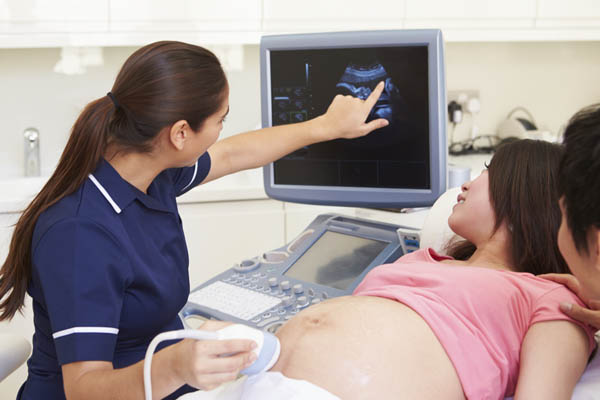
When people think of ultrasound, oft obstetric ultrasound is the outset thing to come to mind. For many, it is the very reason they begin to explore the profession of being an ultrasound technologist in the start place! Sonographers (another term for ultrasound technologist) take the unique experience of
playing a function in a female parent'south pregnancy.
These highly skilled healthcare professionals have the responsibility of obtaining images for physicians to monitor a baby during development. Sonographers are often the offset to see many of the heady moments in a pregnancy—the heartbeat, movement, twins, the sex of the baby, etc.
If you lot are here to explore a potential career every bit an obstetric sonographer, continue reading to familiarize yourself with the career path process.
Qualities of an Obstetric Sonographer
All sonographers must possess the power to perform a highly technical skill with a empathetic delivery. Being an obstetric patient tin be a happy and heady time in a mother's life, but it can come with worrisome and sad moments. It is important for a sonographer wanting to piece of work in obstetrics/gynecology to understand that they will exist caring for patients under stress and worry alongside happiness and excitement.
Find a Sonography Plan
Sonographers must undergo formal instruction and training to gain foundational knowledge and skills to practice as an ultrasound technologist. Typically, a ii-year (associates) or four-twelvemonth degree (bachelor'southward) is completed at an institution of college education such as a community college or university.
It'due south very of import to detect the right program to suit your educational needs. Find a reputable programme that has proven its excellence through plan accreditation, not just college or university level accreditation! To find a school accredited by CAAHEP (Committee on Accreditation of
Centrolineal Health Education Programs), start here at https://www.caahep.org/Students/Notice-a-Program.aspx.
A groovy career every bit any healthcare professional person starts with a peachy education… doing your research will aid you be confident that your fourth dimension and coin is being spent in a worthwhile place.
Connect direct with colleges and universities. Click below for affiliate/sponsored program data and to speak with an individual school's admissions representative.
Hit the Books… and Employ
At present that you know yous want to be a sonographer and where you may like to learn the skills to become one, you must complete the necessary prerequisite coursework to utilise to a program. Most sonography programs require an admission process separate from the sponsoring institution. For example, y'all may consummate a year and a half of prerequisites then 2 years of coursework specific to sonography.
Common prerequisite coursework for sonography programs includes anatomy and physiology, physics, college algebra, English, medical terminology, and psychology. Your bookish advisor is going to exist your
new all-time friend!
Complete Your Plan
Once y'all enter your sonography program you will typically complete courses in cross sectional anatomy, sonographic physics and instrumentation, and patient care. Yous will complete didactic, laboratory, and clinical coursework in the specialty areas your specific program teaches.
- Didactic courses present data virtually beefcake, physiology, and pathophysiology that yous see in a clinical setting.
- Laboratory courses give you an opportunity to practice and interruption down scanning techniques sonographers use to acquire reliable, diagnostic images on volunteer scan models or other simulation-based environments.
- Clinical courses are designed to give students experiential hours in diverse sonography settings. Rotations may include clinical time in hospitals, outpatient centers, and physician offices. Students often rotate through various departments to get a well-rounded experience and feel for the professional person piece of work environment. Clinical courses are the place to build the skillset to demonstrate competency and proficiency in the performance of sonographic examinations, caring for patients, and working as a member of the healthcare team.
Rotations may include clinical fourth dimension in hospitals, outpatient centers, and physician offices. Students often rotate through diverse departments to get a well-rounded experience and feel for the professional piece of work environment. Clinical courses are the place to build the skillset to demonstrate competency and proficiency in the performance of sonographic examinations, caring for patients, and working as a member of the healthcare squad.
Becoming a Registered Diagnostic Medical Sonographer (RDMS)
The Registered Diagnostic Medical Sonographer (RDMS) credential is awarded by the American Registry for Diagnostic Medical Sonography to applicants that have completed the necessary didactic and practical experience and successfully pass 1) the sonographic physics and instrumentation examination
and 2) the obstetric and gynecology specialty exam. Certification and being registered through the ARDMS equally a Registered Diagnostic Medical Sonographer is oft a requirement to proceeds employment in most sonography settings.
To maintain the RDMS credential and adept standing with the ARDMS, 30 continuing medical education (CME) credits are required every three years. An annual membership fee is also required. Sonographers frequently obtain these CME requirements through clinical instructorship of students in CAAHEP-accredited programs, attending virtual or live conferences, ultrasound applications grooming from vendors, reading peer-reviewed sonography journals, or even publishing their own case studies and enquiry.
Employ for Jobs
Many prospective sonography students are attracted to the idea of working in an OB/GYN office. However, there are many diverse opportunities for piece of work environments in the OB/GYN specialty:
- Inpatient
- Outpatient
- Stand alone imaging facilities
- Travel/contract
The sonography profession (similar most healthcare professions) has staffing needs during days, evenings, nights, holidays, weekends, and ofttimes requires telephone call coverage depending on the employer's needs. It is important to sympathise that outpatient, day shift positions are often competitive and are a fast-paced
environs. Sonographers that are new to the profession may need to work in diverse settings to gain paid work experience for a robust resume.
Prioritize Paying Off Student Debt
A great strategy in your pursuit of higher teaching is start with the End in
mind. A study from the Federal Reserve states 54% of immature adults took on
debt while pursuing higher teaching. Students often haphazardly start general
education courses without proper research into potential career options or
formulating a career programme. Adequate inquiry and planning into career options
as well as institution of college instruction can help yous minimize the cost of your
didactics.
Learn more about financing your education
Once you've graduated afterwards investing so much time and money into a not bad career, put your income to good utilize. Prioritize paying off student or personal loans obtained to finance your didactics. Involvement (no thing low the rate) can add up fast!
Mutual Indications for OB/GYN Examinations
There are many unlike reasons a physician may society an ultrasound to be performed past a sonographer! An indication is the reason a written report is being performed. For case, a physician may society a pelvic ultrasound to evaluate mail service-menopausal bleeding in a 64-year-sometime woman.
Indications for Gynecologic Ultrasound
– Pelvic pain
– Aberrant menstrual cycles
– Missed menstrual cycle
– Postal service-menopausal bleeding
– Ovarian cysts
– Uterine fibroids
– Intrauterine device placement and/or follow upwardly evaluation
– Ultrasound guidance for other minimally-invasive procedures
Indications for Obstetric Ultrasound
– Pregnancy dating
– Evaluation of fetal anatomy
– Evaluation of fetal growth
– Evaluation of fetal well-beingness
– Haemorrhage in pregnancy
– Pelvic hurting in pregnancy
– Premature rupture of amniotic fluid
– Evaluation of fetal position
Maternal Fetal Medicine (Perinatology)
Maternal fetal medicine (also called perinatology) is a subspecialty of obstetrics. The MFM specialty takes care of high-hazard pregnancies. A pregnancy tin exist considered at a college-gamble considering of either a maternal or fetal result (or both!) hence the name maternal-fetal medicine. Obstetric sonographers may choose to further specialize and piece of work in the perinatology setting. They frequently perform many of the duties listed previously likewise equally advanced studies that aid maternal-fetal medicine physicians (perinatologists) and obstetricians co-manage pregnancies.
Currently there is no ARDMS certification for perinatology, however, many MFM sonographers must consummate additional preparation and didactics to become certified to perform fetal echocardiograms (fetal middle studies). Perinatal sonographers may besides assist with imaging during procedures such as chorionic villus sampling, amniocentesis, percutaneous umbilical blood sampling (PUBS), and other procedures during the perinatal period.
Equipment
Sonographers cannot perform their job without ultrasound units or transducers/probes. The ultrasound unit often includes a console with the controls to optimize images, a keyboard/touch screen, and a monitor for viewing the beefcake being scanned. The transducer or probe is what the sonographer uses to scan the area of interest, often in accord with department protocols.
From the Experts: Interviews with Diagnostic Medical Sonographers:
Chelsey Wright,BS-MIRS, RDCS (AE, PE), RDMS. Learn more virtually ectopic pregnancies and the implications for female parent and baby, and the role that the sonographer plays in diagnosing them.
Sandra Minck, RDMS. Sandra Minck is a Registered Diagnostic Sonographer (RDMS), with over 29 years feel in diagnostic medical sonography. She has focused much of her career on Obstetrics and Gynecology, working in hospitals, clinics, and with private practice OB/GYN physicians. She is also the author of Womb With a View Blog.
Stephanie Eisler, RDMS. Stephanie Eisler, Sonographer, RDMS, shares her story of personal fears and triumphs, and how she turned them into a fulfilling career of which she can say her heart is truly in it.

Sam Callis is a sonographer with experience in clinical practice, higher didactics, and clinical applications training in device industry. She has taught didactic and laboratory coursework in cardiac and full general sonography. Her clinical practice areas include obstetrics/gynecology, perinatology, abdominal/small parts, and cardiac sonography. She is passionate about educating physicians and other advanced practice providers in point of care ultrasound applications to assist with procedural guidance, emergent evaluation, and follow upward through the diagnostic and treatment process.
Source: https://www.ultrasoundschoolsinfo.com/obstetric-sonography-career/
0 Response to "what degree do you need to be a sonographer"
Post a Comment